 Reader Ethan has compiled the two vicinity maps from L1 and L2 into one single map; something I've wanted to do forever but, thankfully, now I don't have to. Go here to check it out. Nice work Ethan!
Wednesday, December 7, 2016
Garrottenford Map
Reader Ethan has compiled the two vicinity maps from L1 and L2 into one single map; something I've wanted to do forever but, thankfully, now I don't have to. Go here to check it out. Nice work Ethan!


Monday, November 7, 2016
Restenford and the Assassins Knot
It's taken me almost 6 years to get to the topic that inspired this bloggertation in the first place: the link between L1 Secret of Bone Hill and it's follow up L2 Assassin's Knot. Or, more specifically, how did the Lakofka's vision for L2 change between the writing of L1 and the final form of Assassin's Knot.
 |
| Garrotten: We're a suspicious lot. |
For those of you not in the know, L2 starts off the day after Baron Grellus of Restenford has been murdered. Pelltar calls upon the PCs to investigate the matter because he's too high profile of a character to do the snooping himself. Plus he claims not to be interested in politics, even though we all know that he's been pulling the strings of Restenford for years now.
He may be too high profile to conduct the full investigation, but that doesn't stop him from inspecting the crime scene. And, fortunately, he's discovered three clues, each of which implicates, he believes, a separate person who was seen in Restenford on the night of the crime. Each of these suspects is a resident of the egregiously named town of Garrotten, a day's travel to the south. A search of the inns, drunk tanks, and brothels of Resty that morning turned up none of these gentlemen; clearly they've fled back to G-town one step ahead of the law. The case is ironclad, right?
Once the PCs travel down the coast to idyllic Garrotten which, as the name not
so much implies as screams in gigantic, bright green neon letters, is home to a highly secretive assassins guild, they will quickly learn that each of the suspects is a prominent, respected member of the community, Abraham the Innkeeper, Balmorrow the Theater Director, and Harpur the High Preist of Osprem. Each claims to have spent the entire day alone in their quarters and thus has no alibi, even though each lives in a communal residence in a small town where even a trip to the outhouse would fail to go unnoticed--it should be noted that the Garrottenford map is possibly the only published D&D material ever to include latrines. Surely at least a servant would have brought them their meals? Nonetheless, none of them has even the slightest motive to want the Baron dead, nor does any of them have the means to sneak into a castle and murder a dude who, despite being an incompetent ruler, is still a pretty tough fighter.
For those who don't know, here's the lowdown on the murder plot as written in L2 Assassin's Knot:
the deranged abbot Qualton, suffering from psychosis induced by a
psionic attack--how many D&D modules ever incorporated Psionics into
the
narrative?-- thinks that if he kills off the baron and marries his
daughter, he'll get to be the replacement baron and move into Grellus's regal abode. So he makes contact with the assassins down in Garrotten.
But since the Lord Mayor of Garrotten, who is
actually a lady named Arness, is in bed with the assassin's
guild--possibly
literally?--she decides to use Qualton's plot to her own advantage.
Ultimately, depending on the success of the PC's investigatory efforts,
the assassins will kill off the Baron's wife and daughter and finally
Qualton as well, leaving the Baron's seat empty for Arness to usurp.
But by implicating three innocent and highly respected members of the community, the assassin has brought the focus of the investigation squarely onto G-town which is problematic for a few reasons:
- The assassin responsible for Grellus's murder is the head of the notorious guild of hitmen that gave Garrotten its name. Have you ever heard the expression don't shit where you eat? By extension, you should also not shit somewhere else and then intentionally leave a shit-stained trail of shit-scented footprints back to your dining room table. Especially when...
- The baron's murderer is not only a professional assassin and CEO of the Garrotten A-guild, but also has a day job working as an advisor to Arrness, Lord Mayor of the town. Arrness is hoping to capitalize on the plot by filling the power vacuum created by the Baron's death--though let's be honest, he was never holding much power anyway. How pleased can she be that now, just as she is ready to set her putsch in motion, she has to deal with a team of investigators at her doorstep? Especially when...
- If the guild was looking for a scapegoat, they had the perfect patsy in the form of Qualton the Abbot, who, besides being thoroughly unstable--which they certainly must have learned when they vetted him as a client--is actually guilty of the crime since he hired the assassin in the first place! Frame him for his own misdeeds and let his psychosis shine through during the trial and your work is done for you; no one bothers casting a glance Garrotten-ward, despite its name.
- Qualton, Abbot of Phaulkon, having lost his marbles because of a psionic attack, is intent on marrying the Baron's daughter in order to take over the Barony. His write-up in L1 specifically says to keep his lunacy under raps until L2. Clearly the PCs were intended to interact with this dude during the investigation.
- In addition to his other real estate in town, Pelltar has a lease on the tower in the Baron's castle. There is specific language in the terms of the lease that allow
him access to the tower even in the event of the Baron's death.
Obviously this was meant to allow the action of L2 to seep into the
castle. As an aside, what kind of landlord signs a lease with that kind of
language in it? [EDIT: It's a deed, not a lease; Pelltar owns the damn tower]
- The dude in the bait shop is actually a spy for the Duke of Kroten. This has absolutely no bearing on anything in either L1 or L2 but I've always wondered if it was originally supposed to have some significance. Was he, in addition to spying for the Duke, the point man for the Guild? The guy who knows a guy who knows a guy who can get stuff done for a fee? If so, would the Duke have known about the assassination effort even before it happened, therefore making him complicit?
In L1 it seems obvious that it was Lakofka's original vision for the sequel that the PCs would be skulking about in Restenford looking for a killer, not racing off to Garrotten right away. The indication that Pelltar would have access to the tower at the Baron's "castle" even in the event of the Baron's death is only significant if the plan was to have someone taking hold of the Baron's throne right away; someone who does not want Pelltar seeking justice for the baron's murder. This implies that maybe Pelltar has to surreptitiously hire the PCs to investigate the crime. Which would make sense if Qualton did manage to take over the Barony; obviously it would be in his best interest to obstruct the investigation at every turn.
Perhaps the bait dealer was intended to be a red herring to distract
them from the case. Or else the Duke of Kroten had some beef with
Grellus, and his spy was gathering intell. Or maybe he doubles as the
point of contact for the assassin's guild. And perhaps there was never
meant to be an assassins guild--maybe it was supposed to be Kroten who
took out Grellus.
Or perhaps Fairwind, the Baroness, was in on the hit, having been humiliated by the milquetoast Grellus's continued incompetence. That actually makes more sense from a quick transition of power stance since Abbot Qualton's insane plot was never going to see him on the throne. But judging by her "haughty" ways and lawful neutral alignment, it seems more likely that she just wants to put as much distance as possible between herself and this backwater burg full of rabble rather than sully her footwear on the streets of Resty ever again.
My suspicion is that TSR decided that they didn't want to spread the adventure out over two separate publications which would have required aspiring DMs who bought L2 to then go out and acquire L1 in order to be able to run the thing. Admittedly, I woulda' been pretty freakin' annoyed if I'd had to do that back when I ran L2 in the 80s. Remember, in the pre-internet days you could only buy what your local supplier put on the shelves, so if they didn't have L1, you couldn't just go track it down on AbeBooks or wherever. So, in order to make L2 a self-contained module, they moved the action down the coast and left Restenford in the dust. And while I find this a bummer in that I think Assassin's Knot would have been a more interesting adventure if the Restenford angle were explored more deeply, I am somewhat mollified in that we get a second, fleshed-out town setting on Lendore Island.
Thursday, December 5, 2013
Rumors of Restenford: Flaming Hooves
In fantasy, as in reality, unsubstantiated rumors are often excellent sources of inspiration, and L1 takes full advantage of this with its rather extensive rumor table that provides information about the setting but also loads of red herrings and as-yet-undeveloped adventure hook. Here is perhaps my favorite inspiring rumor on the list:
This rumor is interesting for being, well, pretty dang intriguing: who is the woman on horseback?"One night I was coming through Kelman Pass when I saw a woman on horseback ride by and cross into the Dead Forest. Her horse's hooves were on fire."
Watch your toes, Lady.

What's she doing in the pass at midnight? Where'd she get that badass horse?
Furthermore, the illustration on the copyright/title page of the module depicts a barefoot young woman--who is perhaps missing a few toes from her left foot--riding a flame-hoofed horse and wearing a fur lined metal skullcap. This is clearly an illustration of the aforementioned "rumor." Pretty cool, right?
Couple this with the fact that the rumor is in italics, so we know that it's a crock o' horse sh*t. This is extra significant since this is the one image from the body of the module that the players are most likely to actually see. If they also hear the rumor about this babe, they are that much more likely to believe it to be true--under the logic that they wouldn't print a picture of a fake rumor. It's a fantastic set up for a red herring, but with no pay-off whatsoever.
Further-furthermore, rather than starting off with "Old Man Codger once saw ..." or "Legend has it ..." this rumor is told in the first person; this is an eyewitness account. That is to say, whoever tells you this is not merely passing on hearsay but is intentionally lying to you. If you're talking to a 9-year-old kid, or an anonymous drunkard in the tavern then, fine, they're just trying to impress you or amuse themselves, no harm done. But if you abide by the Lakofkaesque contradictory stipulation that only Characters of Level know "tales" from the Rumor Table [in the same paragraph, there is a sentence stating that anyone can be in possession of this knowledge], then it may very well be Pelltar or the Baron trying to sell you this load of crap. In which case, rather than offering insight into the adventure setting, the rumor is telling you something about the person you're talking to. If Almax the Druid is feeding you this rumor then maybe he has a sense of humor--he's willing to pull one over on an unsuspecting adventurer. Or maybe he doesn't care for the adventurers and is deviously sending the party off on a goose chase in the woods. And since the person telling you this is determined randomly, the Rumor Table suddenly becomes a sort of Random NPC Personality Generator.
This could be further evidence of the genius of Lakofka, but given the prominently placed illustration of Natasha the 3-toed Cossack, I like to believe that this rumor was initially meant to be true; that Natasha's encounter ended up on the cutting room floor. In an ideal world, TSR would have released L3 Nightmare of Kelman Pass some time in 1982 with Natasha at the center of the adventure. And also in that ideal world L2 Assassins Knot would have been based in Restenford instead of that ridiculously named town to the south, but that's the matter of another post.
Friday, April 12, 2013
Maps of Restenford
Today's post is a bit of a departure from the norm here. Typically, the bibliography of any of my posts is limited to a single tome: Lakofka's L1 Secret of Bone Hill. Today, I'm doing a study of comparative mapology, and for that I'm looking to the internet. What follow are a bunch of maps of Restenford from varying sources over the ages.
We start with the original map of the V. of R.:
It's your basic, no frills map. A spider's web of dark streets, caught in which are several numbered squares and some barbecue-flavored potato chips that the legend tells us are actually trees. Also noteworthy: a river and two bridges but, curiously, no ford--despite the name of the town. A few contours are included; just enough to show that the druid's compound, the abbey of Phaulkon, and the Baron's wretched compound are slightly less likely than the rest of the town to be swept away in the next tsunami. Also, the south bank of the Restin is defended by a palisade while the north bank is not; presumably danger comes from the south.
This map offers a nicely rendered--if a bit plain--landscape surrounding the empty boxes that represent the edifices of Restenford. A fairly straight interpretation of the town and its environs, it does add fields and trees and some riparian touches that make for a pleasing map. Also, it's de-numbered and un-hexed, so it works perfectly as a player's map. The website has a hash of English and--presumably--Russian text that is a bit intimidating to a monoglot like me.
Now an offering from this sweet French site:
 Again, it's a fairly literal translation of the original, but with color and those rendered roofs so that those squares look like houses. Magnifique!
"I thought the map of Restenford was crap. So I fixed it." --R. S. Conley, Batintheattic.blogspot.com
I'll give Mr. Conley credit; it takes guts to call someone else's work "crap" and then offer up as improvement a rendering that, well, is eye-catching for the wrong reasons. The cartographer's uncritical eye for his own work is refreshing in its own way.
Shoddy crayonmanship aside, Conley's map is actually fairly well thought out; this is where his "fix" gains some credibility. The map displays good use of contours to convey a decent sense of the topography--but watch out for the cross slope on the road--and, if you zoom in, the river is actually nicely rendered; one can almost imagine spending the afternoon fishing from its banks or throwing rocks into the current. Also, the inclusion of a couple of wells and a millpond (#15) adds a nice touch of pragmatism--though one wonders why there is a second mill (also #15) that is nowhere near water. A windmill perhaps? Also, if those hatchmarks around the castle and other defensive installations are intended to illustrate some sort of earthworks, the contours fail to support this notion. Maybe they're stakes.
Make no mistake, this is not Restenford; it's a map of a separate town called Bernost, though Mr. Conley informs us that you can use the Restenford key from L1. Despite a similar trajectory, the river runs in the opposite direction of the Restin, there are no piers jutting out into the flow, and the burned out guard station (#32) has moved outside the city walls. Strangely, though Bernost seems to be well removed from the coast, the gnome's light house (#36) still sends out its guiding beacon to lost mariners.
And our last map of the day is actually a birds-eye view from Dungeon Magazine #71, November 1998.

It was part of an adventure called "Priestly Secrets" that involves some goings-on at the old Abbey of Phaulkon several years after the action of L2 Assassin's Knot. It's a slightly simplified version of Restenford with some extraneous buildings removed, which is fine by me. It does a great job of showing space and scale and the topography of the region and takes liberties to make the town look more human than the ham-handed building layouts of the original module would have you believe. Also, that portion of the village on the north bank is now enclosed by a palisade and the Baron's castle has been improved a bit--the new Baron seems to have a better handle on administering the physical plant than his (or her) predecessor had. Plus, there's that odd seawall thing off the shore; what's that all about? A tsunami early warning structure? The gnome's new lighthouse? I don't recall any mention of this structure in the adventure, but it's such a quirky feature that it seems appropriate, in the grand Lakofkian tradition, that it is left unexplained.
We start with the original map of the V. of R.:
 |
| Map 1: from the published module |
Greyhawk meets Harn: Map of Restenford:
 |
| Map 2: courtesy of old.denw.ru |
This map offers a nicely rendered--if a bit plain--landscape surrounding the empty boxes that represent the edifices of Restenford. A fairly straight interpretation of the town and its environs, it does add fields and trees and some riparian touches that make for a pleasing map. Also, it's de-numbered and un-hexed, so it works perfectly as a player's map. The website has a hash of English and--presumably--Russian text that is a bit intimidating to a monoglot like me.
Now an offering from this sweet French site:
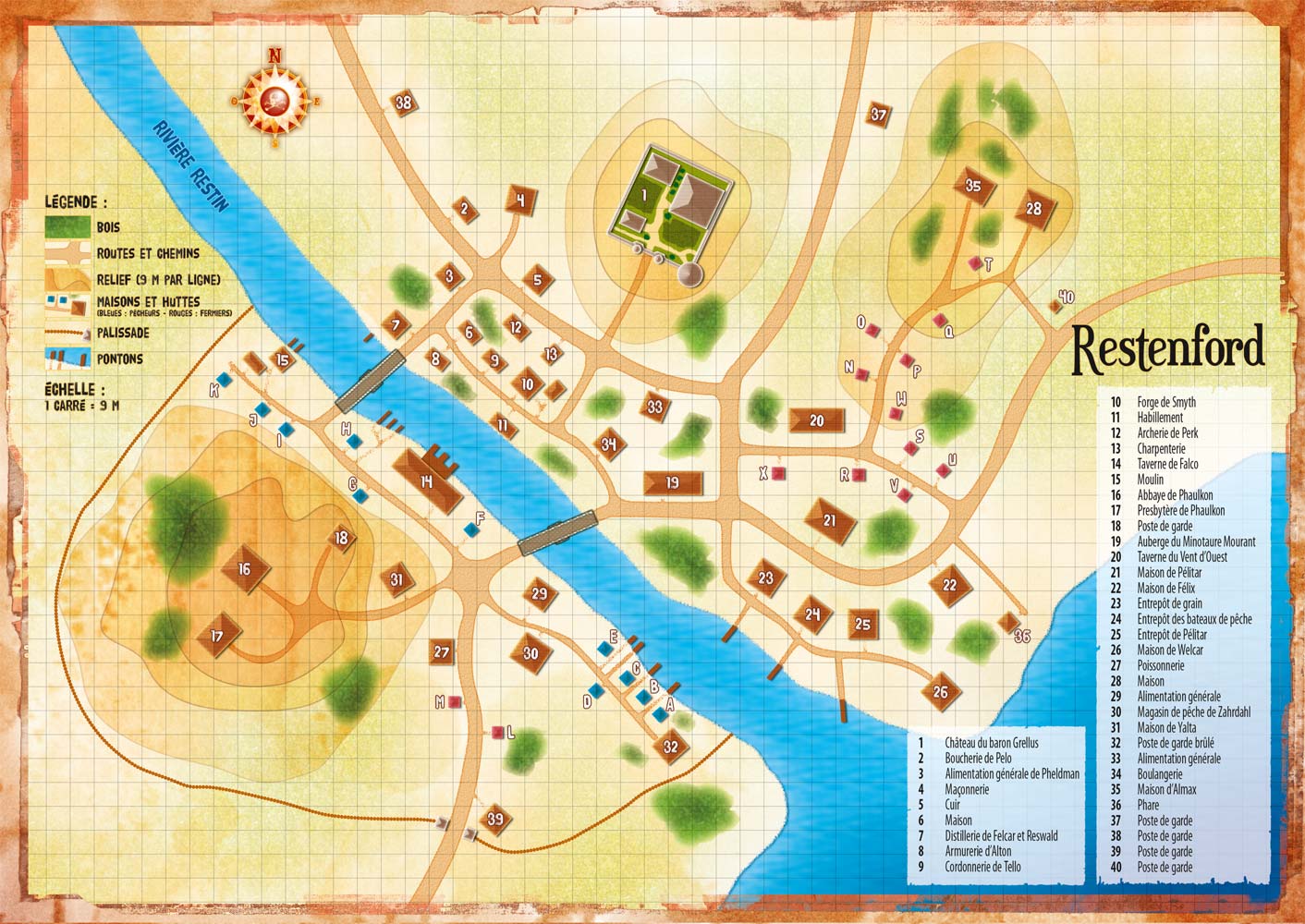
 |
| Map 3: Are you serious? |
I'll give Mr. Conley credit; it takes guts to call someone else's work "crap" and then offer up as improvement a rendering that, well, is eye-catching for the wrong reasons. The cartographer's uncritical eye for his own work is refreshing in its own way.
Shoddy crayonmanship aside, Conley's map is actually fairly well thought out; this is where his "fix" gains some credibility. The map displays good use of contours to convey a decent sense of the topography--but watch out for the cross slope on the road--and, if you zoom in, the river is actually nicely rendered; one can almost imagine spending the afternoon fishing from its banks or throwing rocks into the current. Also, the inclusion of a couple of wells and a millpond (#15) adds a nice touch of pragmatism--though one wonders why there is a second mill (also #15) that is nowhere near water. A windmill perhaps? Also, if those hatchmarks around the castle and other defensive installations are intended to illustrate some sort of earthworks, the contours fail to support this notion. Maybe they're stakes.
Make no mistake, this is not Restenford; it's a map of a separate town called Bernost, though Mr. Conley informs us that you can use the Restenford key from L1. Despite a similar trajectory, the river runs in the opposite direction of the Restin, there are no piers jutting out into the flow, and the burned out guard station (#32) has moved outside the city walls. Strangely, though Bernost seems to be well removed from the coast, the gnome's light house (#36) still sends out its guiding beacon to lost mariners.
And our last map of the day is actually a birds-eye view from Dungeon Magazine #71, November 1998.

It was part of an adventure called "Priestly Secrets" that involves some goings-on at the old Abbey of Phaulkon several years after the action of L2 Assassin's Knot. It's a slightly simplified version of Restenford with some extraneous buildings removed, which is fine by me. It does a great job of showing space and scale and the topography of the region and takes liberties to make the town look more human than the ham-handed building layouts of the original module would have you believe. Also, that portion of the village on the north bank is now enclosed by a palisade and the Baron's castle has been improved a bit--the new Baron seems to have a better handle on administering the physical plant than his (or her) predecessor had. Plus, there's that odd seawall thing off the shore; what's that all about? A tsunami early warning structure? The gnome's new lighthouse? I don't recall any mention of this structure in the adventure, but it's such a quirky feature that it seems appropriate, in the grand Lakofkian tradition, that it is left unexplained.
Tuesday, March 12, 2013
Mob Justice in Restenford
From the Rumor Table:
It's not italicized, so we know that this gruesome tale of lynching in Lendore is a true story.
Consider the phrasing: the half orcs didn't kill the warehouse guard; he "dropped dead during a scuffle" as if the ol' ticker gave out mid-brawl. And then he shows up later that night apparently no longer dead, but the half orcs have already been put to the torch. Can it be any more obvious that the brawl was staged to present the thinnest veneer of justification for a racially motivated lynching?
And again with the phrasing: the half orcs were "found" burned to death; as if their immolation occurred without the general knowledge of the villagers. Even though their corpses were right at the edge of a very small town; the kind of place where half-orc-burnings are not likely to go unnoticed--if not downright celebrated. Despite the tone of mystery this rumor seems to impart, the villagers were more than likely complicit in the offing of the half orcs. And yet because of the tone of mystery, the villagers--or at least some of them--are likely ashamed of it, or at least aware that others might disapprove, and so have tried to distance themselves from the event.
Furthermore, this rumor is also interesting in that its purpose is solely to provide flavor for the town. There is no adventure related to the half orc lynching, unless one chooses to link the half orcs to the band of thieves* camped out on Bald Hill. It would seem that the story is meant to let us know that there is a deep vein of intolerance in this sleepy, little chaotic-neutral village by the sea.
The only perpetrator of the event that we know of is the warehouse guard, so let's get a better look at him. From his description at location 26:
Welcar also has two guard dogs that he takes to work, each having a collar which "nullifies sleep spells for mammals." These collars are described as being given by his employer, who just happens to be the ever-lovin' Peltar; further evidence of the sorcerer's trust issues/paranoia.
But more to the point; does Welcar's involvement in the conspiracy to eliminate the half orcs imply Peltar's complicity with the action? Look at it this way: this is a tiny town, Peltar is going to find out that his security guard played a significant hand in the lynching of some half orcs, yet the security guard acts with impunity. Peltar is nominally the second in command in town--though, in actuality, his authority is supreme. If he felt that the security guard acted out of line, his position would require that he take action against his guard either directly or by advising his sock puppet Grellus to do so. Yet he does nothing. Though it's not unusual for a person in a position of power to shield their cronies/trusted subordinates from justice.
On the other hand, they're half-orcs. Had they been true orcs, the militia would have been in full muster by the time the dudes got within a stone's throw of the town wall. That half-orcs were allowed to enter Restenford, much less patronize an inn, might actually speak to the openness of the community.
But still, faking your death to execute someone under false pretenses? That's pretty devious. The message: Watch your step, outsider, or you're next.
* Oddly, this gang is repeatedly referred to as a "band of thieves" when, in fact, they are orcs. Furthermore, the activities they engage in--ambushing unwary travellers--fall more within the realm of banditry than thievery. In D&D, where terms like thief and bandit and brigand are all very much codified, it's a strange choice of words. Lakofkaesque, even.
"The warehouse guard dropped dead a few days ago during a scuffle in the inn with two half orcs, but I saw him that very night and the half-orcs were found burned to death at the edge of town."
It's not italicized, so we know that this gruesome tale of lynching in Lendore is a true story.
Consider the phrasing: the half orcs didn't kill the warehouse guard; he "dropped dead during a scuffle" as if the ol' ticker gave out mid-brawl. And then he shows up later that night apparently no longer dead, but the half orcs have already been put to the torch. Can it be any more obvious that the brawl was staged to present the thinnest veneer of justification for a racially motivated lynching?
And again with the phrasing: the half orcs were "found" burned to death; as if their immolation occurred without the general knowledge of the villagers. Even though their corpses were right at the edge of a very small town; the kind of place where half-orc-burnings are not likely to go unnoticed--if not downright celebrated. Despite the tone of mystery this rumor seems to impart, the villagers were more than likely complicit in the offing of the half orcs. And yet because of the tone of mystery, the villagers--or at least some of them--are likely ashamed of it, or at least aware that others might disapprove, and so have tried to distance themselves from the event.
Furthermore, this rumor is also interesting in that its purpose is solely to provide flavor for the town. There is no adventure related to the half orc lynching, unless one chooses to link the half orcs to the band of thieves* camped out on Bald Hill. It would seem that the story is meant to let us know that there is a deep vein of intolerance in this sleepy, little chaotic-neutral village by the sea.
The only perpetrator of the event that we know of is the warehouse guard, so let's get a better look at him. From his description at location 26:
"The "old man" who poses as a mere caretaker is really a grizzled but tough fighter named Welcar"It's interesting that the guard merely "poses" as a caretaker. What is he in reality if not a caretaker? Presumably, M. Lakofka meant that Welcar's combat aptitude made him something more than a mere caretaker--he's a 4th level fighter--though it hardly seems an unusual career choice for a retired fighter to take up a gig as a security guard.
 |
| That's Wellcar releasing the hounds. |
Welcar also has two guard dogs that he takes to work, each having a collar which "nullifies sleep spells for mammals." These collars are described as being given by his employer, who just happens to be the ever-lovin' Peltar; further evidence of the sorcerer's trust issues/paranoia.
But more to the point; does Welcar's involvement in the conspiracy to eliminate the half orcs imply Peltar's complicity with the action? Look at it this way: this is a tiny town, Peltar is going to find out that his security guard played a significant hand in the lynching of some half orcs, yet the security guard acts with impunity. Peltar is nominally the second in command in town--though, in actuality, his authority is supreme. If he felt that the security guard acted out of line, his position would require that he take action against his guard either directly or by advising his sock puppet Grellus to do so. Yet he does nothing. Though it's not unusual for a person in a position of power to shield their cronies/trusted subordinates from justice.
On the other hand, they're half-orcs. Had they been true orcs, the militia would have been in full muster by the time the dudes got within a stone's throw of the town wall. That half-orcs were allowed to enter Restenford, much less patronize an inn, might actually speak to the openness of the community.
But still, faking your death to execute someone under false pretenses? That's pretty devious. The message: Watch your step, outsider, or you're next.
* Oddly, this gang is repeatedly referred to as a "band of thieves" when, in fact, they are orcs. Furthermore, the activities they engage in--ambushing unwary travellers--fall more within the realm of banditry than thievery. In D&D, where terms like thief and bandit and brigand are all very much codified, it's a strange choice of words. Lakofkaesque, even.
Monday, May 7, 2012
Knights of Bone Hill
From page 7 of L1:
"The hill itself is rocky, and boulders large enough to conceal a mounted knight occur frequently."Any DM who runs L1 and fails to have at least one mounted knight lurking behind one of these boulders loses 25 points.
Thursday, December 22, 2011
Baron Grellus: Denizens of Restenford Part II
Getting back to the analysis of the personae of Restenford which began with Pelltar the Sorcerer, today I'd like to discuss the ill-fated Grellus, Baron of Restenford. We know from the sequel that he is not long for this world--he will meet his end at the hands of an assassin in L2 Assassins Knot--but what do we know about Grellus the man?
While Pelltar's dossier is not particularly in depth in terms of providing a description of his character, it's downright verbose compared with that of Grellus. The Baron's official write-up divulges only the following information: he is a chaotic good seventh level fighter, he's 44 years old, 6'2", 210 pounds, and has a beard and blue eyes, and his stats (S:18/53, I:13, W:13, D:15, C:16, Ch:12) and magic armaments including a Sword +1 "Flametongue" and a ring of shocking grasp. Nothing is said about his past, the history of his barony, or even his relationship with his family, counselors, or subjects. At least with Pelltar we know that his 4 apprentices are fiercely loyal to him. Of the Baron's household, only the captain of the guard is described as "a loyal retainer" though to whom he is loyal no indication is made.
Though we do learn that the Baron is married to the baroness Fairwind, with whom he has a teenaged daughter named Andrella, nothing is made explicit about their relationships. We know from the Rumor Table that Andrella is rather anxious to become the next Baron of Restenford which speaks more to her ambition than the nature of the Baron himself, but it tends to imply that she sees him as more of an obstacle to her own goals than as a revered parent. We already discussed that there is probably a fair amount of tension between the Baron and Pelltar over the latter's occupation of the castle's tower, resulting in a bit of an inferiority complex in the Baron, and that Almax the Druid may also have something on the Baron in terms of political clout in the community--much as a longstanding parish priest might hold greater sway over the hearts and minds of a small community than its elected leader. Now we learn that even his daughter might be lacking in respect for the dude. It seems hard to avoid the conclusion that the Baron is not a highly regarded leader.
What has he done to earn such a low opinion? Is he a capricious leader? Since he seems to hold such little sway over his subjects, he hardly seems in a position to exercise the sort of tyrannical powers that might make him unpopular. Has he been an absentee liege lord, spending his time off fighting wars? If he were an effective military leader it seems highly unlikely that he would stand for Pelltar's occupation of the tower or the undead presence in the Guard Station. Obviously the people--including Grellus--hold Pelltar's sorcery in greater esteem than Grellus's sword.
Perhaps the all-knowing Rumor Table can help us further understand what makes Baron Grellus such a weak ruler. As always italicized statements are false, according to the Author.
- he is land poor and nearly penniless,
- he has an unguarded fortune hidden under the castle
- he has a statue that turns into a man,
- the Baron is chaotic evil
- there are evil people in town despite what he has to say on the matter.
Furthermore, the second rumor--which indicates that his fortune is "unguarded"--implies that the general population feels that stealing his fortune might be an option to consider. Well, if the baron's not doing anything with it, why not? Again, respect for his authority must be dangerously low if the populace is openly discussing the possibility of robbing their own liege lord. Is it their chaotic alignment talking? Sort of makes Pelltar's over-the-top security measures seem more justified.
The statue-man rumor is a reference to the Stone Guardians in the lower level of the Baron's castle. Stone Guardians are a new species of golem and their presence in the rumor list is a warning that, when you do try to steal the Baron's treasure you should be wary of any statues. But again, we're talking about raiding the Baron's castle here; the man can't get any love.
In rumor 5, Grellus's purported belief that there are no evil people in town reveals that the citizenry feels that the Baron is out of touch with the goings-on of Restenford and that he cannot be trusted to keep them safe from evil. Add to this the perception that the Baron himself might be evil in rumor 4 and this might explain why Pelltar and the Druid are held in higher regard than the Baron. In reality, there are only 1.5 evil people in town--Zardahl the Trickster, bait dealer/spy for the Duke of Kroten, and the schizophrenic Abbot Qualton--but only when he is in his deranged state--so who, really, is out of touch? But again, the perception is that the Baron is either unwilling or unable to fight evil within the town.
Another useful source of information on castle denizens is the Garrison Location Chart. Let's see what it reveals about the baron:
He is likely to be found in the following locations (italicized comments are my own):
- Pelltar's tower--3%/ 1% at night; as mentioned, he's likely either seeking counsel from Pelltar--or trying to eliminate him.
- Throne room--along with, quite literally, everyone else in the castle.
- Fairwind's quarters--40% day/90% night; well, they are man and wife.
- His own quarters--95% day/98% night; who doesn't like their alone time?
- Lower Level--25% day/6% night, chatting with Djinn Balooshi? Counting his treasure? In the dungeons for some S&M play with Fairwind--who is, according to the Chart, the only other person in the castle who ever goes down to the lower level.
- Servant's Room (20c) 1-2--nighttime only. Or perhaps when Fairwind is not in the mood the Baron seeks the comfort of a plump, young scullion? Nobility being no less resistant to carnal desire than anyone else, this is hardly unusual; but would Lakofka make the affair so explicit? I fear this may be a typo.
More than likely he was once a knight of some significance who served the Duke (or a higher authority) well and was rewarded with/condemned to a barony on the fringe of society. But it seems his skills in administering a barony do not live up to his prowess on the battlefield; his realm is a chaotic land filled with dangerous criminals and monsters, his subjects are disloyal and openly discuss treason, yet he seems to take no action to address any of these matters. His subjects rightfully seek authority in others; we have reason to suspect that the sorcerer and druid are held in higher regard than the ineffectual Baron. Also, his inaction in regard to the numerous rumors of violence in the area indicate that perhaps even his once-vaunted military achievements are beyond his current capacity; he has lost his nerve. Despite his impressive frame, he is an impotent shell of a man. Knowing that he lacks the respect of his subjects and even of his daughter--who, though only a teenager, is widely rumored to have ambitions for his throne even whilst still he sits upon it--he holds desperately to the one truly powerful thing in his possession: the treasury.
Subscribe to:
Posts (Atom)